


Our Mortgage FAQs
Want to know more about mortgages from Harpenden Building Society? We know that choosing and applying for a mortgage can be hard to navigate with various confusing aspects, especially with lenders who are heavy on the jargon.
At Harpenden, we aim to simplify the complex when it comes to mortgage lending – individually assessing applications and each person’s circumstances to help brokers provide the right solution, whatever your property ambitions.
Although we deal directly with intermediaries and don’t offer specific advice, we’ve compiled these Mortgage FAQs to help you understand how our mortgages work, including repayment methods, fees and how we approve applicants.
See the common questions below – we hope the answers give you the information you need!
Your home may be repossessed if you do not keep up repayments on your mortgage.
If you fail to keep up with payments on your mortgage a ‘Receiver of Rent’ may be appointed and your rental property, or other property used as security, may be repossessed.
Frequently Asked Questions
At Harpenden Building Society, we offer loans on properties across England (including Isle of Wight), and Wales and dealing exclusively with mortgage brokers and intermediaries.
If there is land or a home in these regions which you’d like to purchase or remortgage, please speak with your independent mortgage adviser. Once you’ve discussed the details and your financial situation, they can get in touch with us.
No, we don’t offer specific mortgage advice or guidance ourselves, as we deal only with intermediaries. So, if you’re a new mortgage customer with a property you want to purchase or remortgage, we recommend seeking independent mortgage advice.
This approach is designed to ensure you receive the most appropriate mortgage advice across the market and is part of our continued commitment to responsible lending.
If you don’t already have or know an independent mortgage adviser, or you wish to check that an adviser you are dealing with is regulated by the Financial Conduct Authority then search the Financial Services Register.
Loan-to-value (LTV) is the amount of mortgage loan you owe against the value of your property.
As you make monthly repayments on a capital and interest mortgage, your loan balance gradually reduces. This increases your equity in the property and lowers the loan-to-value (LTV) ratio over time.
In contrast, for mortgages arranged on an interest-only basis, the loan balance generally remains unchanged, as the monthly payments cover only the interest and do not reduce the original amount borrowed.
A Decision in Principle (DIP) is a document that shows how much you may be able to borrow for a mortgage, without needing to submit a full mortgage application. It allows you to make an offer on a property before you have a formal mortgage offer in place, reassuring the seller that you are likely to be able to secure the funds needed to proceed.
Before applying for a mortgage, you may be asked to provide an DIP, as it gives an indication of your borrowing capacity. Many estate agents and property sellers request sight of a DIP at the offer stage.
A DIP confirms that Harpenden Building Society is, in principle, willing to lend up to the amount shown. However, it is not a mortgage offer and does not guarantee that one will be made. Any mortgage offer remains subject to a full application, property valuation, and you meeting our lending criteria and policies.
A standard variable rate (SVR) is a type of variable rate mortgage with an interest rate that can fluctuate. If the interest rate falls, your monthly mortgage repayment will reduce, but if the interest rate goes up, so will your monthly repayments.
We decide when to increase or decrease this standard rate, based on certain economic factors, and we’ll notify you in writing 10 working days in advance of any change to the interest rate. This will also advise you of the new monthly repayments required to maintain the term of your mortgage. Changes in interest rate may vary in accordance with our current Mortgage Terms & Conditions.
A Standard Variable Rate (SVR) mortgage is a mortgage where the interest rate can go up or down over time. This rate is set by your lender and is usually the rate you move onto after a fixed or discounted deal ends.
Unlike some mortgages, an SVR does not automatically change when the Bank of England base rate changes. However, lenders may still decide to increase or reduce their SVR when the base rate goes up or down.
Because the rate can change at any time, your monthly payments can also rise or fall.
When you apply for a mortgage, we’ll need to conduct certain verification checks to confirm who you are and where you live. We use a combination of electronic identification and documentary evidence to verify your identity and your permanent address, and you may be required to provide documents.
Get full details of the identification required for mortgage applications with Harpenden Building Society.
Harpenden Building Society offers several methods of paying back your mortgage, including Repayment, Interest-Only and Part Capital/Part Interest options. People have various financial situations, mortgage needs and repayment strategies, and these three separate methods of repayment offer flexibility to suit different circumstances.
Below is a summary of the mortgage repayment methods we offer and how they work:
Repayment Mortgage
With a Repayment Mortgage, you make monthly repayments over an agreed number of years to cover the capital borrowed and interest charged.
As your debt gradually reduces over the course of the mortgage term, the interest amount paid each month reduces, as you’ll start to pay a greater proportion of the capital owed.
At the end of the term, provided all monthly payments are received on time, your mortgage will be fully paid off.
Interest-only Mortgage
An Interest-only Mortgage allows you to make monthly payments that only cover the interest on the amount borrowed. So, during the mortgage term, you’re not paying off any capital of the sum borrowed. Instead, you just pay the interest incurred on the loan to purchase your property, land or agreement.
You’ll need to repay the full mortgage amount in one lump sum at the end of the mortgage or when you sell the property – you must outline how this will be achieved at the outset.
We will only provide interest-only mortgages if we are satisfied you’ll be able to repay the mortgage at or before the end of the term.
Part Repayment/Part Interest Mortgage
A part repayment, part interest-only (also called a part & part mortgage) is a loan that is split into two parts and each part is repaid in a different way.
Repayment (Capital & Interest)
- You pay both the loan amount and interest
- The balance reduces over time
- This part will be fully paid off by the end of the term (assuming all repayments are made)
Interest-Only
- You pay only the interest each month
- The loan amount (capital) does not reduce after
- You must have a suitable repayment strategy in place to pay this part off at the end of the agreed mortgage term.
If you have a part and part mortgage, you pay off some of your mortgage as you go, but not all of it. When the mortgage term comes to an end, there will still be some money left to pay off.
Example: If you borrow £300,000: £180,000 repayment & £120,000 interest‑only basis
- £180,000 Repayment Part – Balance will be paid down over the term of the mortgage
- £120,000 Interest-only – Balance will still be owed at the end of the term and will need to be repaid
When you apply for a mortgage with Harpenden Building Society, we make various checks to see if you pass our affordability assessment and meet our other lending criteria. These include credit searches, identity checks, income and employment checks and property valuations.
Once these checks are complete, our underwriters will review your application in full and decide whether to approve the mortgage.
If your application is approved, you’ll receive a binding mortgage offer that’s valid for six months, giving you enough time to accept the offer and complete your mortgage, if you choose to proceed.
Yes. We look at many types of income when assessing affordability. We lend to people who are employed, self-employed, retired and contractors.
When assessing applicant finances and whether you meet our affordability and lending criteria, we look at salary, bonus and commission, as well as things like pension, drawings, dividends, rental income, investment income, trust income and maintenance.
When considering either a mortgage or additional borrowing on your mortgage, it’s important to be sure you can afford the mortgage payments, as well as your bills.
As people have widely varying financial situations and commitments, your independent mortgage adviser will need to provide us with details about your income, expenditure and other assets, plus your mortgage requirements. Then we’ll be in a position to make an individual assessment based on your personal circumstances.
Mortgages from Harpenden Building Society are available for periods ranging from 2 to 35 years, depending on your age.
You must arrange buildings insurance cover for the property offered as security, as a condition of the mortgage offer. We’ll ask the valuer inspecting your property to advise us of the building’s reinstatement value.
You may need to provide us with evidence of insurance for the reinstatement value and for the interest of Harpenden Building Society to be noted in the insurance policy document before we can advance funds to you under the mortgage at completion.
Arrangement fees apply to some of our mortgage products. If this is the case for your chosen product, details of the fees will be outlined on the European Standardised Information Sheet (ESIS), provided to you by your independent mortgage adviser.
Yes, we require a valuation to be conducted on the proposed security to assess if it’s adequate for mortgage purposes. This fee must be paid to us upon application and is non-refundable once the valuation has been carried out.
The valuation report is for the sole use of Harpenden Building Society to make a lending decision. Therefore, we strongly recommend getting your own detailed survey from an independent qualified surveyor.
Our valuation fees differ, depending on the property price/value.
When we provide you with a mortgage offer, and at any time that you ask us, we will provide you with a Tariff of Charges covering the operation and repayment of your mortgage.
You can view our Mortgage Tariff of Charges.
A Joint-borrower-sole-proprietor (JBSP) mortgage allows a direct family member to be added to the mortgage to increase the amount of borrowing available. All borrowers on a JBSP mortgage are equally responsible for the mortgage and maintaining the monthly payments, however only the borrower(s) who will reside in the property will be the legal owners. This is different to a standard mortgage where all borrowers are also jointly owners of the property.
Below are a selection of JBSP mortgage FAQs to help answer any queries you may have in relation to this type of mortgage.
Up to four people can apply for a JBSP mortgage with Harpenden Building Society: up to two borrowers as the proprietors, and up to two additional joint borrowers.
Harpenden Building Society only allows direct family members (i.e. parents and children) to act as non-occupying or ‘supporting’ borrowers on a JBSP mortgage.
Yes, Harpenden Building Society asks all non-occupying borrowers on a JBSP mortgage to take Independent Legal Advice (ILA) prior to completion.
A guarantor has agreed to be responsible for repaying the mortgage if the primary borrower(s) fail to make the payments. Guarantors are expected to be able to support the whole mortgage; they are often required by lenders when the borrower’s creditworthiness or income is not sufficient to qualify for the mortgage alone.
Joint borrowers on a JBSP mortgage and guarantors are legally responsible for the mortgage debt, however all borrowers on a JBSP mortgage share equal responsibility for the mortgage from the outset, while a guarantor only provides additional security for the lender by agreeing to repay the mortgage if the primary borrower(s) default.
As with non-occupying borrowers on a JBSP mortgage a guarantor has no ownership interest in the property. However, all joint borrowers are named on the mortgage, while a guarantor is not.
Need more help with your mortgage?

Why choose Harpenden?
Discover why people choose Harpenden Building Society’s mortgage lending solutions and how our tailored approach helps brokers solve complex needs.

Your mortgage feedback
Leave us a review for a chance to win a charity donation. We welcome your mortgage feedback as it helps improve our services.

Difficulties paying…
See what solutions Harpenden Building Society can provide if you’re having difficulty paying your mortgage, due to changes to your financial situation.
Latest News
Community
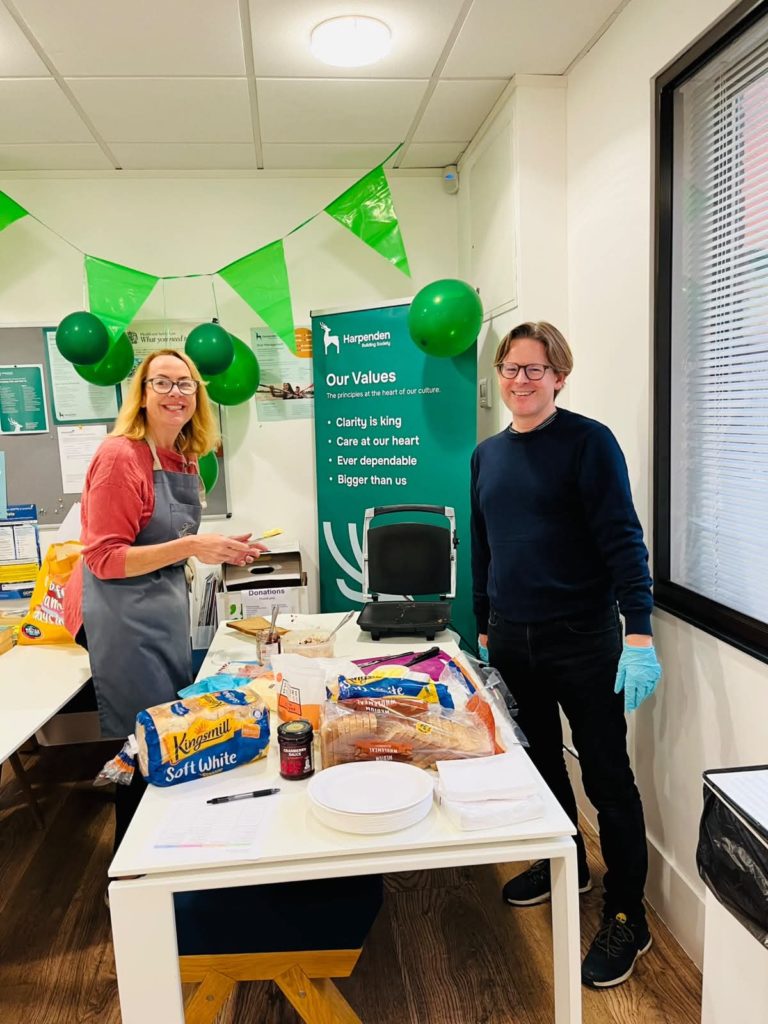
Toastie Tuesday for Herts Young Homeless
Toastie Tuesday was back on the menu on Tuesday 20th October. Our much-loved Toastie Tuesday made a welcome return, bringing colleagues together for great food and an even greater cause. Toastie…


Industry
Fixed Rate product update
FOR INTERMEDIARY/PROFESSIONAL ADVISORS ONLY. NOT FOR CONSUMER USE.
Community
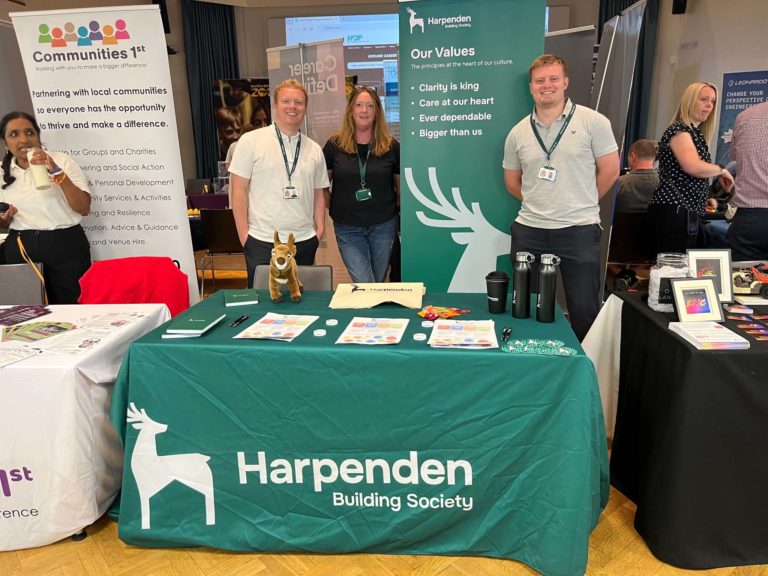
St Albans & Harpenden Careers Fair 2026
On a glorious Friday in early July, four of our colleagues volunteered at the St Albans and Harpenden Careers Fair, held at Rothamsted Research Conference Centre. This annual event brings together…

Latest News
Harpenden wins ‘Best Local Building Society’ at the 2026 What Mortgage Awards
Harpenden Building Society wins ‘Best Local Building Society’ for the 12th year in a row, as well as being marked ‘Highly Commended’ in the ‘Best Specialist Lender’ and ‘Best Large…

Community
Harpenden Support – Mia Caruso
From a young age I have been fascinated by cars and have grown up as a Ferrari enthusiast. Watching the F1 from a tiny age was a normal part of…

Community
Herts Young Homeless – Volunteering
One of the most rewarding aspects of working for a building society is the opportunity to volunteer alongside colleagues. At Harpenden Building Society, every colleague is given two days each…

Community
2026/27 Charitable Grants: Harpenden Hopper celebrates ten years of community service
HBS grant: £3,000 The Harpenden Hopper has marked a very special milestone: ten years of helping local people get out, stay connected and remain part of everyday life in the town….